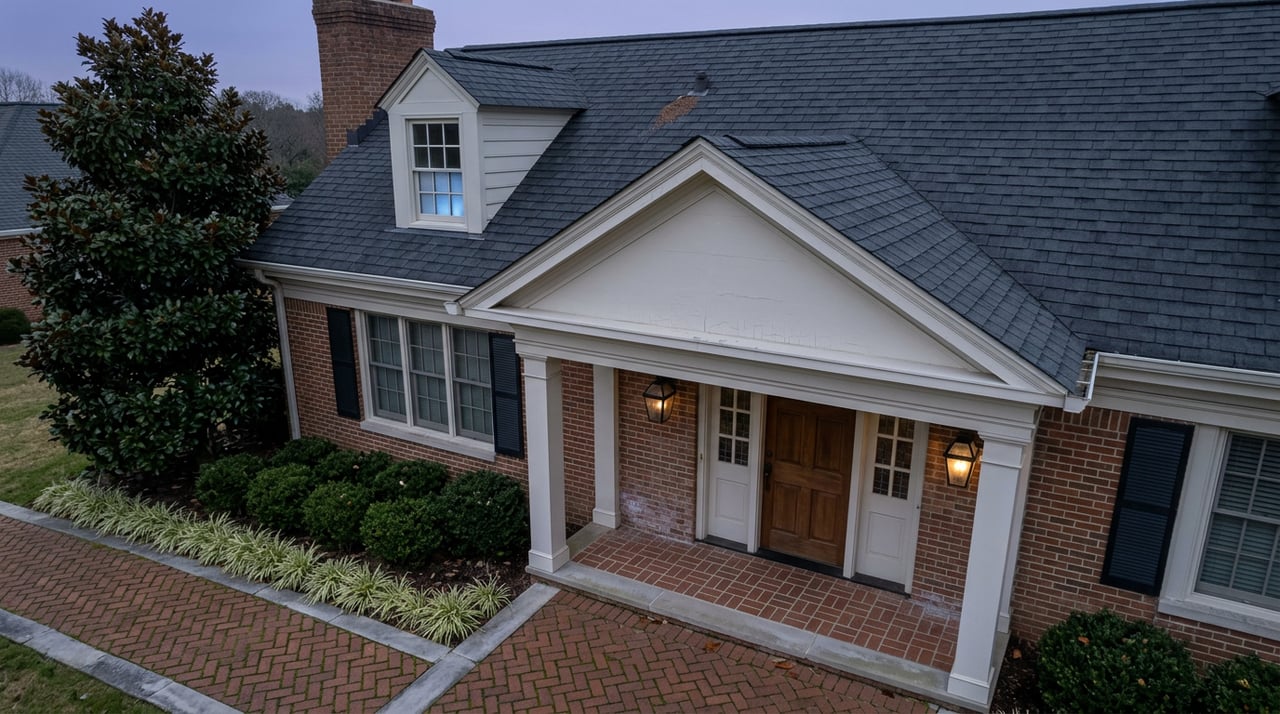
The Paper Trail Hiding Behind Every Cobbham And Boulevard Listing
September 17, 2026
September 17, 2026
In July, Athens-Clarke County planning staff sat down with a routine-looking request from a corner property at Boulevard and Chase Street: swap out the fascia trim on an existing canopy. Nothing structural. No new footprint. Just a design change to something that had already been approved once before.
Staff recommended denying it.
That single line in a public staff report tells you more about selling a home in Athens' historic districts than any generic "old house buying guide" ever will. The Historic Preservation Commission is not a rubber stamp, and it does not treat small requests as automatically safe. If a canopy fascia can get flagged, so can the fence you added without asking, the driveway you widened, or the porch rail you swapped out five years ago and forgot about.
Athens-Clarke County currently maintains 16 local historic districts and 44 individually designated landmarks. Cobbham, established when John A. Cobb subdivided his farm and started selling lots in 1834, sits roughly between Prince Avenue, Hill, Reese, and Pope Streets. Boulevard, laid out a few decades later as a streetcar suburb about a third of a mile north of downtown, runs along the other side of Prince Avenue. The Dearing Street Historic District, built out mostly between 1810 and 1910, covers a tighter band around Broad and Baxter Streets and Milledge Avenue.
Cross one of those boundary lines and the rules change. Inside them, a Certificate of Appropriateness is required before you can make almost any exterior change: new siding or material substitutions, additions, new construction, and site features like driveways, fences, and retaining walls. Some of these get approved at the staff level in a matter of weeks. Others go in front of the full Historic Preservation Commission, where staff write a formal recommendation and the commission votes in a public hearing. A denial can be appealed to the Mayor and Commission, but only within thirty days.
The distinction matters because two houses a block apart can be operating under completely different rules. One sits inside a mapped district and needs sign-off for a fence. The other sits just outside the line and doesn't. If you're not sure which side of that boundary your address falls on, that's the first thing to check before you list, not after an offer comes in.
The Boulevard property in that July case wasn't a first-time applicant. Its own record showed a September 2023 approval for canopy additions, a January 2024 approval for a storefront window change, a February 2024 approval for an accessory structure, and a May 2026 approval for fencing modifications that, notably, didn't cover the canopy change the owner was now asking about. That's five separate county actions on one parcel in under three years, each one logged and each one specific to exactly what was approved and nothing more.
This is the part sellers underestimate. A Certificate of Appropriateness isn't a one-time hurdle you clear before a renovation and then forget. It's a running file attached to the address. Every fence, every window swap, every accessory structure creates its own entry. When a buyer's agent or an attorney pulls that history during due diligence, gaps show up as gaps. A house with an undocumented deck rail or a carport that was never reviewed doesn't have a defect in the deed. It has a paperwork hole that surfaces the moment someone starts asking the right questions, and in a historic district, someone usually does.
There's a second layer that catches even careful owners off guard. Along the Milledge Avenue corridor between West Broad Street and South Lumpkin Street, front yard trees are protected under a special district overlay. Removing one, even a tree that's clearly on your own property, requires both a zoning permit and a Certificate of Appropriateness before the chainsaw comes out.
Most homeowners think of tree rules as something that applies to developers clearing a lot for new construction. In this corridor, it applies to the oak in your own front yard. If a past owner took down a diseased tree here without pulling those approvals, that's another entry missing from the file, sitting quietly until someone goes looking for it.
| District or Overlay | What Triggers Review | Typical Review Path |
|---|---|---|
| Cobbham | Exterior material changes, additions, fences, driveways | Staff-level or full HPC hearing, depending on scope |
| Boulevard | Same as above, plus signage and canopy elements on mixed-use lots | Staff-level or full HPC hearing |
| Dearing Street | Exterior alterations to designated structures | Staff-level or full HPC hearing |
| Milledge Avenue Corridor overlay | Removal of protected front-yard trees | Zoning permit and COA, both required |
If you own a home inside one of these districts and you're thinking about selling in the next year, the useful move isn't to panic about a denied canopy request three blocks away. It's to get ahead of your own file.
None of this means historic districts are harder to sell in. Homes in Cobbham, Boulevard, and along Dearing Street carry a kind of character that newer subdivisions can't manufacture, and buyers pay for that. It means the homework looks different than it does in a subdivision built in the last twenty years, and the sellers who do that homework early move through the process with fewer surprises.
Does a pending or denied Certificate of Appropriateness show up in a title search? Not directly. It lives in the county's planning and zoning records rather than the deed itself, which is exactly why it's easy to miss unless someone specifically checks for it.
Do I need a COA to sell my house as-is, without any exterior changes? No. The certificate is tied to making a change, not to the sale itself. The issue only surfaces if past changes were made without one and a buyer's due diligence turns that up.
Is Normaltown subject to the same review? Normaltown has plenty of the same historic housing stock and heavy renovation activity, but the strictest documented design review standards apply specifically within the mapped Boulevard, Cobbham, and Milledge Avenue districts. If your home is in Normaltown, it's worth confirming directly with the Planning Department which rules apply to your specific address.
If you're weighing a sale in one of Athens' historic districts and want a second set of eyes on what your property's file actually shows, Linda Maples has spent four decades working through exactly this kind of local detail with Athens and northeast Georgia sellers. A quick call before you list beats an unexpected question during due diligence.
Work with experienced Georgia real estate agent Linda Maples to buy or sell your dream home. Get a free valuation and view local listings.
Get In Touch With Linda To Learn More

2405 W Broad St Ste 150 Athens GA 30606